A sophisticated fallout shelter requires more than reinforced walls, blast protection and an NBC/CBRN air filtration system. It also needs to know when the danger is present.
Nuclear radiation, toxic gases and many chemical threats cannot be detected by human senses. You cannot see them, smell many of them or reliably know when contaminated outside air has reached dangerous levels.
This creates one of the most important questions for any fallout shelter:
How will you know when to activate your NBC/CBRN protection system?
An advanced filtration system provides protection when it is operating correctly and at the right time. But even the best NBC/CBRN filtration equipment cannot provide the intended protection if occupants do not know that a threat has developed and fail to activate the system in time.
That is why every sophisticated fallout shelter or bunker should include a sophisticated detection and monitoring system.
Detection Is the First Line of NBC/CBRN Protection
The purpose of an NBC/CBRN detection system is straightforward: detect the threat before occupants are exposed to it and provide the warning required to take protective action.
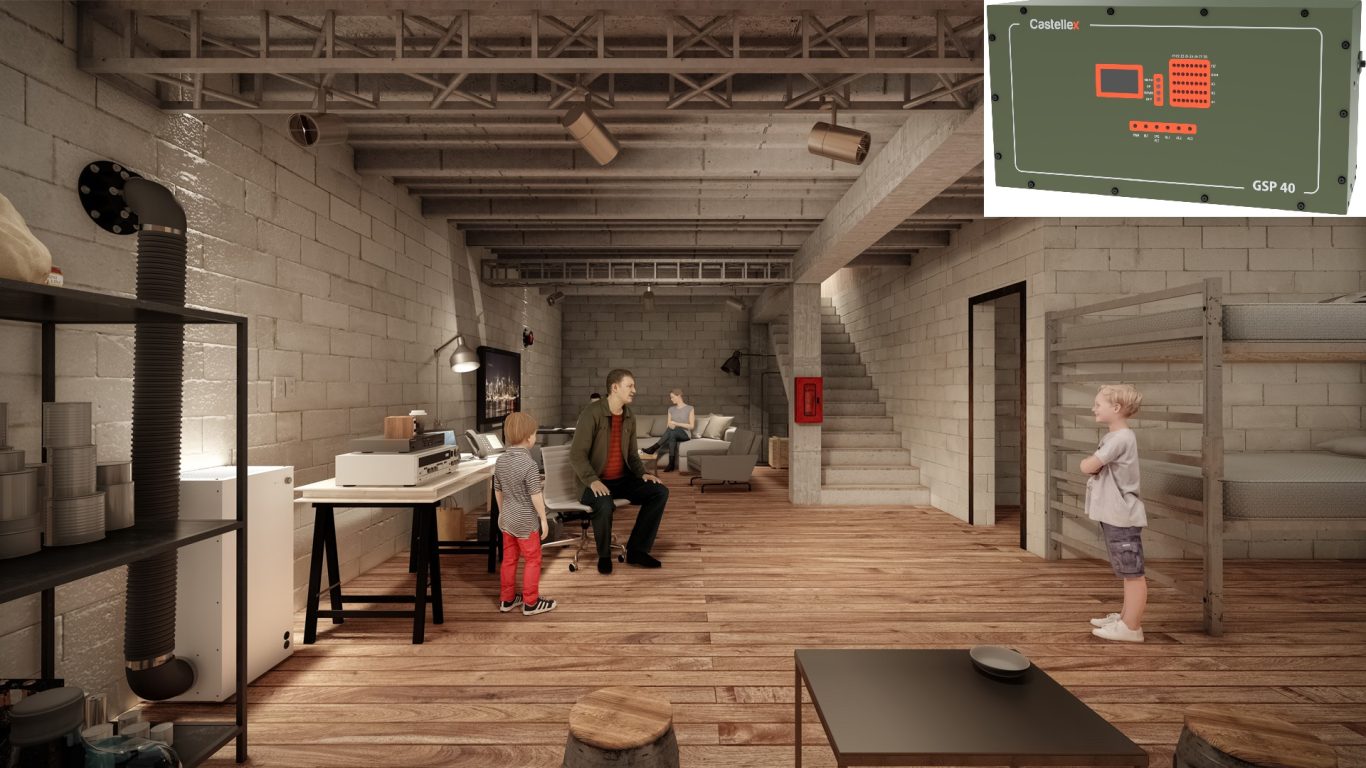
The Castellex GSP40 Gas & Radiation Monitoring Panel is designed for continuous monitoring of connected gas and radiation detectors.
Multiple detectors can be connected to a central monitoring and control panel. Measurement data is continuously transmitted to the GSP40, where incoming signals are analysed against predefined safety thresholds.
When programmed limits are exceeded, the system provides clear audible and visual warnings.
This gives shelter occupants the information they need to react immediately, activate NBC/CBRN filtration and implement the shelter’s protective procedures.
Detection provides the warning. Filtration provides the protection. A properly designed shelter needs both.
What Happens When Communications Fail?
Modern life has created an enormous dependence on external information.
Television, mobile phones, internet services, emergency alerts and social media normally provide information about developing emergencies. Under ordinary circumstances, this information can reach millions of people within seconds.
A nuclear conflict is an entirely different situation.
Major communication networks, electrical infrastructure and internet connectivity can be disrupted or unavailable. Local information can become fragmented, delayed or impossible to obtain.
A bunker owner should therefore never design the safety of a shelter around the assumption that an external warning will always arrive.
Imagine being inside a remote shelter with no mobile network, no internet connection and no reliable external communications.
Is the outside environment safe?
Has radiation increased?
Is there a chemical threat?
Is it safe to operate in normal ventilation mode?
Should NBC/CBRN filtration be activated?
Without independent monitoring, occupants can be forced to make these decisions with insufficient information.
In-shelter detection removes this dependency.
The shelter has its own monitoring capability and does not need to depend entirely on somebody outside telling its occupants that the environment has become dangerous.
Remote Fallout Shelters Need Independent Detection
For large estates containing several shelters located relatively close together, it can sometimes be practical to design a detection arrangement serving multiple protected areas.
The correct configuration depends on the estate layout, distances between shelters, the threats being monitored and the overall protection strategy.
Remote shelters are different.
A remotely located bunker should have its own independent detection capability.
A shelter designed to remain operational during a major nuclear, chemical or CBRN emergency should not depend solely on communications with another building, security centre or monitoring station.
If that connection disappears precisely when the emergency begins, occupants still need to know what is happening outside their protected environment.
For remote shelters, independent gas and radiation detection is therefore a critical piece of the protection system.
Castellex GSP40 – Continuous Gas and Radiation Monitoring
The Castellex GSP40 Gas & Radiation Monitoring Panel has been developed for protected environments where continuous monitoring is required.
The wall-mounted system receives measurement signals from connected detectors and processes the information continuously.
An OLED display provides real-time information about system operation and the condition of connected detectors. When predefined hazard thresholds are exceeded, visual indicators and an internal audible alarm warn occupants.
The GSP40 supports up to 40 inputs, allowing a detection system to be configured around the requirements of the protected facility.
Applications include:
- Fallout shelters
- Nuclear bunkers
- Bomb shelters
- NBC/CBRN shelters
- Mobile and containerised shelters
- Protected residential facilities
- Industrial facilities
- Laboratories
- Technical rooms
- Other high-security protected environments
The GSP40 also incorporates provision for emergency backup power, an essential consideration for equipment intended for environments where normal infrastructure cannot be assumed to remain continuously available.
A Modern Bunker Is a Complete Protection System
A serious fallout shelter is not simply a reinforced underground room.
It is an integrated survival environment.
Structural protection provides resistance against physical effects. NBC/CBRN filtration helps protect the internal atmosphere. Positive pressure helps prevent contaminated outside air from entering through uncontrolled leakage paths.
But detection tells the entire system when the threat exists.
This is why detection should not be treated as an optional accessory added after the bunker has been completed.
It should form part of the shelter design from the beginning.
A properly designed protected environment combines:
Detection → Warning → Filtration → Positive Pressure → Protected Environment
Removing detection from that chain means occupants can be left waiting for information from external sources at exactly the moment when those sources are least reliable.
Designed and Assembled in the United Kingdom
Castellex designs and assembles the GSP40 in the United Kingdom with a focus on the requirements of serious NBC/CBRN protected environments.
For equipment intended to remain ready for emergencies, quality, durability and dependable functionality are fundamental requirements.
The same principle applies across the Castellex approach to shelter protection: individual components should work together as a complete system rather than being treated as unrelated pieces of equipment.
From NBC/CBRN air filtration and positive-pressure systems to gas and radiation monitoring, Castellex provides solutions for private bunkers, fallout shelters, commercial protected facilities and larger shelter projects worldwide.
Don’t Wait for Someone Else to Tell You the Air Is Dangerous
A fallout shelter is built for the circumstances in which ordinary infrastructure can no longer be trusted.
Its detection system should follow exactly the same principle.
When external communications are functioning, they provide valuable additional information. When those communications disappear, an independently equipped shelter still needs the ability to identify dangerous conditions.
You cannot protect against a threat you do not know is there.
For sophisticated fallout shelters, nuclear bunkers and NBC/CBRN protected facilities, independent gas and radiation detection is therefore a fundamental part of the protection strategy.
The Castellex GSP40 Gas & Radiation Monitoring Panel provides the monitoring and early warning required to help occupants recognise hazardous conditions and activate protective measures when they are needed.
Detect the threat. Activate the protection. Protect the shelter.
Castellex for Your NBC/CBRN Needs
From detection to filtration, Castellex provides integrated protection solutions for fallout shelters, bunkers and protected facilities worldwide.
Castellex for AIR.


